Showing posts with label Cultural Observations. Show all posts

Wednesday, 18 February 2009

The Stalactite of Doom....

Sorry for the generally lavatorial nature of recent posts - I have now found my level and I am resolutely sticking to it. Here, therefore, are some interesting things that happen when you have a wee on a trans-Siberian train.


As on English trains, trans-Siberian train toilets deposit their contents directly onto the track. Unlike English trains, however, this is not done discreetly; instead of a pause followed by a strange suction noise, the bottom of the toilet bowl simply flips open and you can thus see your offering deposited at speed onto what must by now be a very sewagey train track.

Now this is fine in theory, but given that Siberia in February is at night twice as cold as your average home freezer, it does not work very well in practice. Understandably, the natural reaction of water or watery liquids in Siberia is to freeze, which, as the picture a couple of posts ago illustrates, means that the collective wee forms a giant pissy stalactite below the train. This makes going to the loo frankly rather interesting.

After you gingerly place your bum onto the freezing metal seat and begin to wee, the first thing you feel is your behind being bathed in a pleasant hug of warm steam. This, we think, happens because your warm wee temporarily melts the frozen dribbe of water in the bottom of the toilet bowl, but we cannot discount the possibility that the top of the 'wee column' has also been melted, and that steamy wee comes back up the toilet bowl to meet you. Which is not a very pleasant thought.

The excitment continues when you then insert toilet paper into the bowl. As the ice (and wee) at the bottom of the loo bowl have by this point refrozen, the loo roll sticks to the ice. And as the now expanding column of wee means that the toilet bowl does not fully close, a stream of Siberian air rushes in, meaning that the part of the toilet paper not glued to the bottom of the metal toilet bowl bounces around like a Mexican jumping bean on speed. It is rather hard to make it go away.

And that, I promise, is the end of all loo-related posts. At least until I eat some Sichuan hotpot....

Friday, 13 February 2009

An Interesting Cultural Observation


Russian toilet paper has no hole in the middle. Just thought you’d like to know.

Of course we all dress like Britney...

Last night, Katie, Sophia and I decided to go out for a drink. This is not as easy as it seems, as in Russia there aren’t really pubs –it’s either a restaurant or a nightclub, the latter of which means strict dress codes, inflated prices and ‘face control.’ As this is about as far from our scene as you can get, going out in the evening in Russia has been limited – certainly in central Moscow it is difficult to find anything that isn’t an incredibly up-itself swanky nightclub for Moscow’s nouveau-riche. After initially drinking mojits in what was essentially a coffee shop, we resorted on the second night to drinking beer in the hostel, which was where the extended conversation with the Indian-Malaysians that disrupted the blogging came into it all.

Given this, we were quite excited when Katia recommended to us a Beatles-themed café and bar called Yellow Submarine, which has food, beer and live music. The bar itself was fun (and very sixties/seventies- themed, with prog-style airbrushed portraits of bands on the walls and every item on the menu named after a Beatles song), but unfortunately Katie, Sophia and I were then cornered by a young Russian guy, who despite having quite limited English claimed to work as an English-Russian translator and interpreter (if he does, it would explain a lot about the quality of English translations in these parts). In the course of the evening he berated Sophia for the crime of being German, sang loudly and terribly to ‘accompany’ the singer who was playing, claimed that when he met Italians they’d all flashed him to show that they had ‘big balls,’ and, most bizzarely of all, repeatedly insisted on wanting to touch Katie’s nose. When, after about two hours of interesting ‘conversation’ he eventually decided to go to the toilet, we quickly paid for our food and beers and made a hasty getaway for fear of another two hours in his company.

He was absolutely desperate to impress, and talking about Sophia about her experiences in Tomsk and to Katia about modern Russia, it seems that most young Russians are, like him desperate to be ‘western’ (although few are strange freaks like he was). However, as few have had the opportunity to travel outside the country, most of the information Russians have about western fashions and culture comes from the songs, films, and TV. This has led to some interesting misconceptions –our friend last night was mightily confused as to why the few foreign travellers he has encountered do not try to dress like Britney Spears, who is apparently the pinnacle of style among young Russians. We tried to explain that basing your fashion choices on the decisions of a woman who has a history of failing to wear underwear, shaving her head and hitting a photographer’s car with an umbrella might not be the wisest policy, but he continued to insist that young Russian girls (rightly in his view) aspire to look like Britney. Apparently Sex and the City is also very popular here, which explains why so many Russian women insist on teetering about in four inch heels despite the fact that the ground is covered in ice. According to Sophia, the female students in Tomsk all dress like this despite the -40C temperatures, and bulimia and anorexia are big problems.

This obsession with image, fashion and style may also explain why Russian clubs, even outside of Moscow, try so hard to be ‘cosmopolitan,’ Although it did have the Yellow Submarine, Ekaterinburg also boasts the most ridiculously try-hard concept for a club that I have ever seen; a club cum car park. At Park King, you pay to drive your car – provided, of course, that it passes the desirability test - into what is essentially a car park. The ‘music’ is then provided by the assembled cars (resulting, I imagine, in a hideous cacophony of techno and bad house), and drinks are served at inflated prices. This seems not only stupid, but a surefire way of ensuring that your formerly desirable car will end the night scratched and covered in sick. Right.

At the moment, being young and Russian thus appears to be a labour-intensive and rather thankless business – being freezing and tottering around in -30 temperatures to try and look like a TV star doesn’t really sound like a particularly fulfilling way to go about life. Possibly if more actual opportunities become available to young Russians, and if they ever get the chance to see a bit more of the world, this try-hard desperation will lessen, but at the moment I do feel a bit sorry for them. Except for our friend last night. He'd be weird anywhere.

I Love "Sverdlovesk"


Sverdlovsk/Ekaterinburg is a very nice town; spacious and calm, with nice wide streets and a big lake (now frozen) right in the centre. It does, however, have the dubious fame of being the place where the deposed Tsar Nicholas and his entire family were shot and bayoneted to death in 1919 after the Communist government decided that they were too great a threat. The same year, Nicholas’ sister Elizabeth was thrown down a well, and after they realised she was still alive they buried her alive and set her on fire. In honour of these achievements, the city, which was originally named Ekaterinburg after Empress Catherine the Great (who did not in fact die having sex with a horse, but did, apparently, have a room devoted to bizarre sex objects), Lenin decided to rename the city Sverdlovsk after the commander (Sverdlov) whose idea it was to do the Romanovs in.

Since 1992, the city has reverted to the old name of Ekaterinburg, and now Romanov-iana is back in a big way; the church has not only constructed the huge and ostentatious Church of the Blood on the site where the Romanovs were killed, but indeed has made the entire Romanov family (Tsar Nicholas, Tsarina Alexandra, their four daughters Olga, Tatiana, Maria and Anastasia, their haemophiliac son Alexei, and Nicholas’ sister Elizabeth) official Orthodox saints. The Church of the Blood is thus mega-blinged up, and houses the most expensive icon in all of Russia. Seeing twentieth century historical figures (and not particularly bright ones in the case of Nicholas and Alexandra) decked out in the full regalia of Orthodox saints was certainly one of the many surreal experiences I’ve had in Russia. Unfortunately you’re not allowed to take pictures in the church, but you are (of course) allowed to buy tourist tat, meaning that I am now the proud owner of this rather glorious Romanov necklace.


What adds to the strangeness of the whole experience is that despite the official renaming the town is still often known by its old name of Sverdlovsk (and there is a sign saying 'I Love Sverdlovesk, the picture of which I was hoping to put up but which forgot to put on the flash drive). The name Sverdlovsk proudly stands above the railway station and the statue of Sverdlov continues to stand prominently in the town square. Only in post-Communist Russia could a city have both a big fat cathedral to the Romanov ‘saints,’ and a big fat statue of the guy who decided to do them in – and only in post-Communist Russia could both still be venerated by large groups of the population.

Russian Guards...

Now, about 50% of the times that we’ve mentioned that we’re going by train through Russia, the first thing somebody has said has related to Russian border guards, who appear to be known and feared worldwide. This seems to be with good reason; apparently a recent study revealed that 60% of Russian border guards are mentally unstable and should not be trusted in command of weapons (said study was commissioned after a couple of unfortunate incidents in which deranged border guards went on shooting sprees and killed their colleagues).

Given this reputation, and given that my previous encounters with border personnel across the world have rarely been entirely pleasant, we expected that our meeting with the Russians would be nothing if not memorable. Alas, we were to be disappointed. Perhaps since the publication of said study the recruitment policy has been changed (i.e. they are not recruiting from category A prisons), for the guards that came on the train were all very young and not very threatening at all. The guard who came into our carriage was a woman not much more than my age, who was the possessor of an imposing fur hat but did not appear to be at all psychotic, mentally unbalanced, or trigger-happy. She even smiled at us, and there was never any talk of a fine. Perhaps the Russia-Mongolia border will furnish us with better stories but for now I unfortunately have no interesting/scary Russian guard stories to report. We did get another stamp though, which always makes me unreasonably happy.

Kelly also enquired about drug mule bunkmates. Again, sorry to disappoint, but our cabin mate going across the Russian border was a Ukrainian babushka who I very much doubt had a secret career as a heroin trader. She did supply us with lots and lots of food which may, I suppose, have contained barbiturates or something, but of all the people I’ve ever met on my travels she didn’t immediately strike me as one of the more dodgy. She was about 65 and was going to visit her son in Moscow, which didn’t strike me as suspicious either, but then again, she could have been a Ukrainian spy en route to crack the secrets of the Kremlin. Maybe.

Concrete Rainbows and Beautiful Views

After our 36 hour trundle through the flat, grey and rather unlovely landscape of eastern Poland and western Ukraine, we woke up to find ourselves finally approaching the city of Kiev. To save on a night’s accommodation, we’d decided to take the train to Moscow that evening, and thus we had about ten hours to kill wandering around the Ukrainian capital. After booking our tickets and putting our luggage safely in lockers, we headed off naively in search of the centre and/or the grand cathedral that was pictured in gaudy blue and yellow posters throughout the rather grand train station. Given that we had no guidebook, not a single word of Ukrainian at our disposal and absolutely no knowledge about Kiev, this was a rather questionable strategy, and initially we found ourselves wandering down backstreets and then through a bustling market in which the products for sale included plastic bags from famed western ‘designers’ such as Marks and Spencers and Peacocks, which if you are a fashion conscious but poor Ukrainian can be yours for the princely sum of 10p.

After much confusion, we did finally find the centre, although the cathedral continued to elude us - despite ten hours of wandering all around the city centre, we never laid eyes on it. I have now come to the conclusion that said cathedral might actually be in Lviv. Anyway, after eating what turned out to be a really delicious lunch of veal with ceps and tomato sauce (much appreciated after two days of living on bread and apples), we meandered around aimlessly for the next eight hours.

‘Faded’ would be a fair description of Kiev; seventy years of socialism have evidently left quite a deep visual impact on the city, which still has a rather ‘back in the USSR’ vibe. Unlike Prague - which having been largely spared from the twin scourges of wartime destruction and post-war reconstruction has quickly returned to its art nouveau, Habsburgian best - Kiev looks just as one imagines an eastern bloc city to look; gloomy, grey and, well, a bit shit. There are some wonderful nineteenth century and art deco buildings, but with few exceptions they are falling apart, with paint peeling off the windows and graffiti adorning the walls. And then there are lots of the brutalist blocks so beloved of sixties town planners, most of which appear to be in various stages of decay. The aura of depression was also heightened by the fact that the city was cloaked in a thick, grey fog; we climbed the hill that advertised itself as a viewpoint over the city only to find that the viewpoint furnished us with only a beautiful view of Ukrainian fog. All was not lost, however, for the park was also home to some other Kievan curiosities. The first was an alarmingly large number of wedding parties; car after car was blinged up with crepe paper and ‘Anya loves Sergei’ number plates, and most of these cars seemed to house brides, who were wandering around in the grey slush in strapless, snow white wedding gowns. The second was a big fat rainbow, lovingly rendered in concrete by some enthusiastic party architect. Unlike Prague, which quickly tore down all of its Communist monuments (Stalin was replaced with a giant neon metronome) Kiev seems to be in no hurry to pull down the Soviet statues. Perhaps they can’t afford to, or can’t decide what they would build instead, for there is certainly no love lost between Ukrainians and Russians and little evident nostalgia for the USSR. Fittingly, however, the rainbow is now situated next to an endearingly crap bright blue dodgem rink, on which two slow, sad dodgems were knocking forlornly into the wall as the radio pumped out tinny American pop. It was basically post-socialism crammed into a single scene.
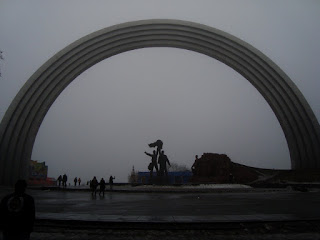


All in all, the blue and yellow ‘We love Ukraine’ banners that were bedecked all around the city seemed to be more of an aspiration that a reality, for Kiev today is certainly looking a little sad. Despite this, it was a place that was surprisingly easy to feel fond of, and not merely in the ‘so rubbish it’s good’ sense. The city has not only a faded grandeur, but a visible defiant pride in its relatively new independence. This was shown by the fate of the historic 11th century monastery St Michael’s (which dates from the period when Kiev was the capital of the first identifiably Russian nation, Kievan Rus). The monastery was torn down in the 1930s by the USSR, a fact which clearly enraged the sensibilities of Ukrainians (after all, Russia got to keep most of its historic churches intact). Upon independence in 1992, the new government decided that the only possible solution was to rebuild the monastery exactly as it was when it was demolished. Work was finished in 2002, so the St Michael’s Monastery that stands today, despite looking like its existed for centuries, is actually only six years old.


Sticking it straight back up again like it had never been away shows a certain moxie, as does Ukraine's general attitude towards their Russian neighbours. The recent gas issue gave rise to the following - amazing - poster, in which the newspaper Glavred gives the Prime Minister, Yulia Tymoshenko (who isn't getting along so well with her erstwhile ally, President Yushchenko), credit for getting the gas supplies restored:


It is a very interesting time to visit Kiev, as I imagine that in another ten or fifteen years the city will look quite different from today. Clearly change is on the horizon, although the pace is being restricted both by the fact that the country has been bankrupted by the economic crises (and has had a few difficulties in remembering to pay its gas bills) and by Russia’s continuing belief that the Ukraine belongs to it. Ukraine, however, is certainly defiant, so who knows what the future will bring. Probably more political squabbling and arguing with the Russians, actually. Anyway, despite being a bit rubbish, I actually quite liked Kiev (mainly because I felt a bit sorry for it), and I definitely wish it well.

Wednesday, 4 February 2009

Nashledanou Praha (Defenestration Nation).


First of all, credit goes to Jon for my new blog header, which is very lovely and makes the blog look oh-so much cooler. I am still disappointed that he didn't come up with the GIF-tastic, WordArted, hideously tacky version that he promised, but this certainly goes someway to make up for the Gunther-torture. I've put a link to Jon's design blog so anyone who's interested can check out his designs and tees.

Anyway, this morning we've had our interview with Nancy, the orange-haired Trinity moderator, so as of tomorrow we should (hopefully) be fully TEFL-qualified and free to teach our wonderful language to curious kidlets and grownups across the globe. Which means, of course, that it's time to leave Prague and continue our journey eastwards; this evening we're off on a 36-hour jaunt to Kiev and from there it's pretty much straight to Moscow, which is where I imagine I'll next be able to update on our progress. Time to crack open the Russian book, buy some cigarettes to use to 'befriend' guards and border officials (apparently this generally works a treat), and brace ourselves for the cold.

It's all very exciting, but at the same time I shall be sad to say goodbye to Prague, a city where I have spent a very happy month and where I could very easily live and grow fat. I shall miss the cake, the goulash and dumplings, all the lovely folk at Oxford TEFL, the cheap beer, the snow, golem statues, Konvikt pub, the mulled wine and potato pancakes in Old Town Square, the wonderful buildings, and, of course, the spirit of dear, departed Rudolf. And lots of other stuff that I have momentarily forgotten. Excluding the busted orange lamp in my room that insists on falling on the floor all the time and the thoroughly repugnant tram inspector who fined me 700 Kc for having mistakenly double stamped my ticket (a huge, completely unreasonable woman who probably once enjoyed life as a minor Communist official), there has really been nothing unpleasant about my time here.

Prague has many claims to fame, both of the price of beer = very low and the lots of important stuff happened here varieties, but I think that one particulary Prague fact I discovered last week is quite special and worthy of sharing before I leave. It was in this city that the wonderful verb to defenestrate was coined, for the Czechs have a long and venerable history of killing people (generally public officials, members of the town council or irritating clerics) they dislike by simply chucking them out of windows. The town council got the push en masse in 1419, and then in 1618 it was the turn of two Habsburg imperial governors to discover the power of gravity, although the latter managed to survive by landing on a steaming pile of manure. There have been incidents of defenestration as late as 1948, meaning that the country deserves the moniker of Defenestration Nation that I have bestowed on it. I am aware that this sounds like a terrible 90s Europop hit, and am indeed trying to come up with a ditty worthy of the title. You are very lucky this blog doesn't have sound....

Digression over, sorry. Anyway, for now it's goodbye to Defenestration Nation and off to the land of vodka, fur hats, frozen lakes and CCCP tat. I have rubbed the supposedly lucky statue of St. Jan Nepomucky pictured above (this guy avoided defenestration by instead being thrown off the Charles Bridge), which apparently means that I shall one day return to Prague. I certainly hope that's true, as this city agrees with me, but for the time being it's nashledanou and thanks for all the beer!

Sunday, 1 February 2009

A War on Trees


Having now spent four weeks in Prague, I feel like I know the place fairly well - not only am I no longer lost in the streets of Stare Mesto, but I can even tell my knihkupectvi (bookshop) from my kadeřnictvi (hairdressers), vaguely understand menus in Czech, and recommend nice restaurants and bars to perplexed tourists. I must admit, however, that there are still things that still have me a little mystified, and foremost among them is the question of what the police in Prague are actually paid to do.

Before I start, I must admit that compared to some of the other police I've encountered around the world, the Prague force are shining beacons of competence and moral rectitude. When I was doing my Spanish course in San Andreas, Guatemala, the balcony of the police station was everyday filled with about 20 fat drunkards who spent their day leering at girls, and despite this rather sizeable crime-fighting force for a large village, every day you'd hear people discussing last night's tally of murders and shootings. In Kenya, the police basically operate as a bribing racket - once you've paid your way into the force, you can spend your days at the side of the road happily accepting bribes from matatu drivers to 'overlook' the fact that they are driving hideously overloaded death-traps apt to crash at any moment.

I should not, thus, complain, but what does confuse me particularly about the Prague police is the fact that their job seems to primarily consist of wrapping inanimate objects in police tape. Real criminals don't seem to bother them unduly; there is a drug dealer, for example, who every night you can find on the same street just off Old Town Square. He is not a particularly discreet drug dealer, his general greeting invariably being 'drugs? You want some drugs?' Nor is he particularly fearsome, being around 5'4" and having the physique of a limp stick of celery. This rubbish drug dealer, however, is allowed to operate unimpeded, for the police are far too busy dealing with the scourges of misbehaving chairs and left over Christmas trees.

Our apartment is opposite a police station, and for three weeks there lay on the pavement outside a growing pile of broken chairs, all lovingly wrapped up in police tape. This confused us; were they saving a parking space? Had the chairs misbehaved in some way? Were the police just really, really bored? The chairs are evidently benign, however, compared to the threat posed by another type of evil object: Christmas trees. A few days ago we were walking across Namesti Republiky - a big square near to where we live - when we saw about three police vans show up and stop at the side of the road. One even had its sirens on. Thinking, naively, that the police were doing standard police-type things such as catching criminals, we continued on our way. When we walked back through the square half an hour later, however, all that was left of their presence was a poor, abandoned Christmas tree, left in the middle of the tram lines and covered in reams and reams of police tape.

People, I am at a loss. Has President Klaus become bored of the war on terror rhetoric and instead declared war on trees? Is there a war on wood and all objects made from it? Are the police just trying to use up their tape after an over-zealous clerk put in a bumper order? I have no clue whatsoever. Any suggestions, of course, are muchly welcomed, for I would hate to leave Prague without having solved this crime-fighting condundrum.

(Sadly I didn't have my camera with me when we came across the tree, so Slanty Santy, our fondly-remembered tree from this year, has had to substitute).